Groningen
Music makers get a seat at the negotiating table or end up on the menu
AI music is not going away. How we deal with it, and where we let the value flow, is what we can still decide.
This month SmartLabel launches RadioMatic, a service for AI-generated background music for the business market. It creates room to develop the company's other projects, which let value flow where the music industry does not.
In November 2025, three AI songs sat at the top of the Spotify and Billboard charts. A band that does not exist, The Velvet Sundown, reached a million monthly listeners before it became clear they had been made with AI. In June, more than half of all daily uploads to Deezer were fully AI-generated[1].
This is the reality of the music market in 2026. We can fight that reality or do something with it. The question is no longer whether AI music exists, but which uses we allow, under what conditions, and who shares in the proceeds. The music industry will either get a seat at the negotiating table or, if we are not careful, a place on the menu.
The lesson of 2008
In 2008, Spotify went live. To fill its library with music, it had to sit down with the major labels. They saw a fix for the falling income that followed the arrival of the internet and were keen to take part, but on their own terms.
Leaked contracts and later reporting showed that the labels negotiated not only royalty rates, but also advances, minimum guarantees, breakage and equity stakes. How such income, not tied directly to streams, was shared with artists was opaque and depended on individual contracts.
The labels negotiated as rights holders, not as representatives of music makers. When Spotify went public in 2018, they cashed in their shares for more than a billion. The artists who made the music that built that company received only a small part of it, and only after heavy public pressure. Sadly, growth in the overall market did not automatically mean a bigger or livable income for individual makers.
History repeats itself
Once again, the majors are acting as rights holders, not as representatives of musicians. In 2024, Universal, Warner and Sony sued the AI generators Suno and Udio for mass infringement. They warned the court that AI would "replace the work of human artists". Within a year and a half of filing the case, Universal and Warner settled and made licensing deals with exactly those companies. Suno even bought Warner's platform Songkick.
In June of this year, the American musicians' union AFM sued Universal and Warner over this[2]. The complaint mirrors what happened in 2008: without compensation or credit, the labels licensed their musicians' work to AI companies and kept the proceeds for themselves. While they shout the loudest that they stand up for artists, they are once again defending the status quo and lining their own pockets.
Fortunately, there is also hope. On 31 July, a German court ruled in favour of GEMA, the German collecting society, in a case against Suno[3]. Six well-known works were enough to show that the model Suno uses had stored these works and reproduced them recognisably. The market for generative music now seems to be splitting in two: one side that trains AI on protected work, and one that uses public or licensed data.
A licence that is far from finished
The solution the industry is now working on sounds reasonable: licences on training data, with an opt-in or opt-out for makers. But it needs a lot of work before it functions well. Give everyone who ever released a song a one-off euro per track and you have bought the right to generate music forever. Nobody has become richer. The dataset, however, is one hundred percent licensed.
A badly designed training licence can therefore buy makers off with a one-off fee, while the model goes on producing unlimited commercial value. That risk can only be avoided with recurring payments, revenue sharing or other forms of ongoing participation.
Because even if the data is licensed, that does not necessarily mean the artist gets paid. A licence from one rights holder also does not mean that all the makers involved get paid. A track contains several layers of rights. Who receives money depends on which layer is licensed and how contracts and collective arrangements are set up.

Last year, 250 million dollars in music money went unclaimed in Europe[4] and flowed back to the industry instead of to the makers. That is why it matters that makers have their affairs in order, so collecting societies know where the money should go. Artists still too often fail to arrange this properly, because it is more opaque than it needs to be.
On top of that, the devaluation of music has been going on for years and certainly did not start with AI. For years, more music has been released than a person can listen to. AI did not cause that trend, but it has accelerated it. Music is everywhere, and no lawsuit will change that.

What we think matters
What stays scarce and will keep its value is someone playing music live for an audience. The band playing tonight. The singer-songwriter who silences a room. That is where the value is shifting, and as far as we are concerned, that is where the money should go too.
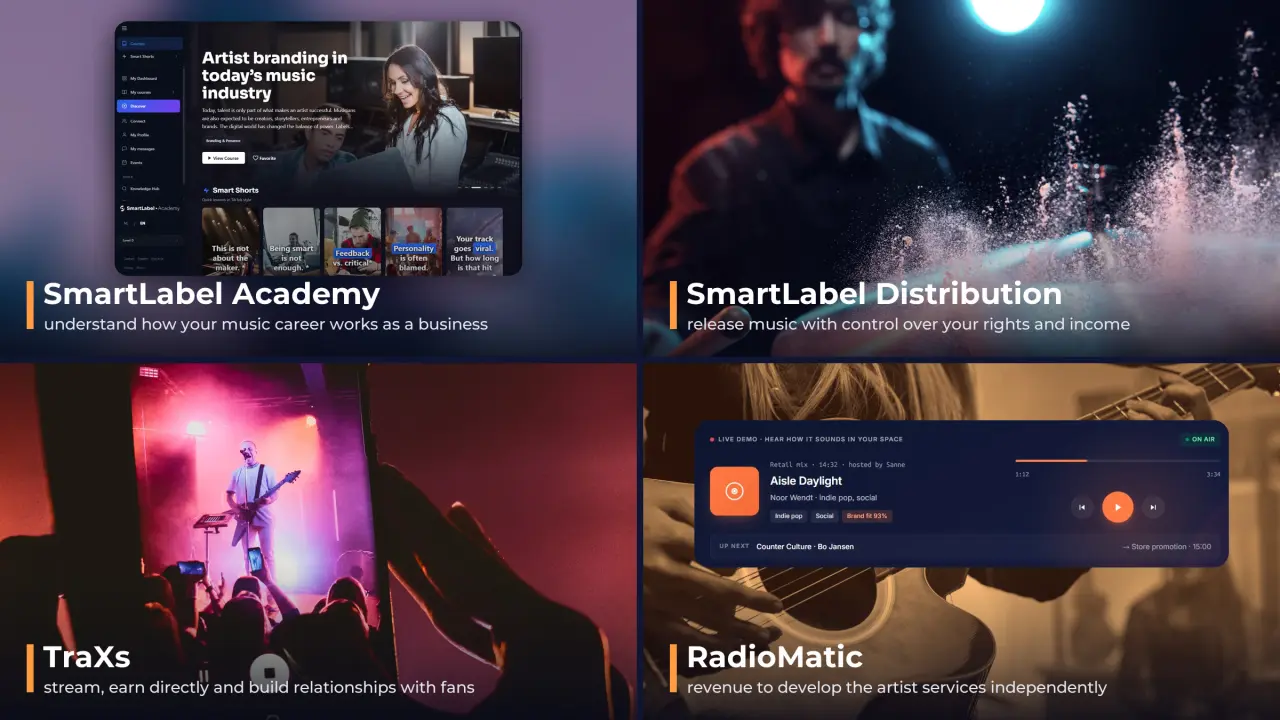
That is what we do with RadioMatic. This new platform generates functional music for spaces where music matters but is not the reason you come, such as shops, showrooms, offices, waiting rooms, healthcare and government. Places where music is nice to have, but nobody comes for it. Places where you do come for the music, such as cafés and clubs, we stay away from on principle. There, music is the product, and that has to be made by people.
In some situations, RadioMatic replaces existing background music made by people. We do not deny that. We deliberately choose uses in which music is not the main reason for a visit. This is how we build independence from the industry and can develop products that help music makers.
We are also as open as possible about how we make AI music. At the moment it is still almost impossible to claim 100% clean training data, but that is what we are working towards. As the platform and this corner of the industry develop, it becomes ever easier to train models on licensed music, material with demonstrably free rights of use, work in the public domain and synthetic audio. Our goal is ultimately to build our own model. Then we will have full insight into the training data and can show what is possible.
Until then, we work with partners who share that aim and have clear documentation, and we check their work as well as we can with fingerprinting. We can also switch between models easily. For each use, we choose the model with the best demonstrable combination of clean data, reliability and musical quality. A minimum level of transparency and clean data is a hard requirement.
Background music pays for human art
We live in a world that has demonstrably failed for years to take good care of the people who add real value. Not only in the music industry. And we will not change that overnight. In fact, we will have to play by the existing rules before we can break them. We saw that with TraXs. We want to build a music streaming service that is good for makers, but we keep running into barriers from the industry. RadioMatic gives us the chance to operate in both worlds. We need money to reach our goals, and RadioMatic gives us a way to earn it.
In this way, background music pays for art made by real people.
Note to editors, not for publication
For questions, interviews with founder Jonathan Oudekerk or images: Guy van Koolwijk, PR & Communications Lead, press@smartlabel.media, +31625084017. Logos, portraits and background: smartlabel.media/en/press.
About SmartLabel Media
SmartLabel Media is a music-tech company from Groningen, founded in 2019. Under one umbrella it builds four ventures: Music Distribution, Industry Business Academy, RadioMatic and TraXs. All with the same goal: giving makers access to their own data, grip on their income and a direct relationship with their audience.